Direct Answer
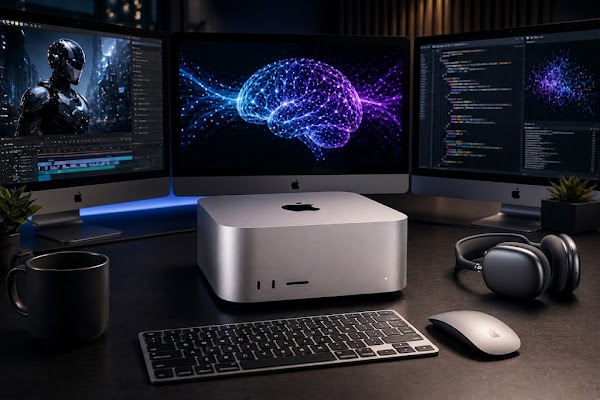
The Mac Studio with M5 Ultra is positioned as a major step up for local AI and graphics workloads. Apple claims up to 4.3x faster peak AI compute versus M3 Ultra and up to 1.8x faster graphics, with configurations that include GPU Neural Accelerators, up to 512GB unified memory, and 1.2TB/s memory bandwidth so you can run large models and demanding creative projects on-device.
Why this matters right now
As generative AI, real-time 3D, and multi-stream 8K video move from niche to everyday tools, local workstation performance determines whether professionals can avoid cloud dependencies. Apple’s latest Mac Studio refresh centers that idea: more integrated AI acceleration, wider memory pipes, and higher I/O throughput to keep large datasets and models on your desktop.
At-a-glance takeaways
- AI-first desktop: M5 Ultra is claimed to deliver up to 4.3x peak AI compute over M3 Ultra, enabling larger on-device model runs.
- Large unified memory: Up to 512GB of unified memory at 1.2TB/s reduces data movement bottlenecks for massive models and timelines.
- Faster graphics: Apple cites up to 1.8x faster GPU performance and hardware ray tracing improvements for creators and 3D artists.
- Connectivity and clustering: Thunderbolt 5 (up to 120Gb/s), Wi‑Fi 7, Bluetooth 6, and RDMA-based linking let multiple units combine resources for higher inference throughput.
New architecture in plain terms
The family divides into two target profiles: the M5 Max for high-end single-machine workflows and the M5 Ultra for extreme local scale. Both chips place Neural Accelerators inside the GPU fabric to accelerate the matrix and tensor operations common in modern AI.
M5 Max: single-system horsepower
Designated for developers, editors, and 3D artists, the M5 Max ships with an 18-core CPU and up to a 40-core GPU. Configurations support up to 128GB of unified memory at 614GB/s. Apple also lists third-generation hardware ray tracing and more capable shader cores to smooth complex 3D scenes and speed offline renders.
M5 Ultra: dual-chip scaling
The M5 Ultra is effectively two M5 Max dies fused together. That yields a 36-core CPU, an 80-core GPU, and up to 512GB of unified memory running at 1.2TB/s. Apple claims this configuration can run very large unquantized language models locally and offers double the video encode/decode engines of the M5 Max — enough to play up to 33 simultaneous 8K ProRes 422 streams, per Apple.
Benchmarks and claimed comparisons
The following table summarizes Apple’s performance statements comparing the new M5 Max and M5 Ultra against prior chips. These are the vendor-provided relative figures; treat them as indicative of generational trends rather than absolute user results.
| Benchmark category | M5 Max vs previous chips | M5 Ultra vs previous chips |
|---|---|---|
| LLM prompt processing | 3.9x faster than M4 Max (10.7x vs M1 Max) | 4x faster than M3 Ultra (9.8x vs M1 Ultra) |
| Text-to-image generation | 3.5x faster than M4 Max | 4.3x faster than M3 Ultra |
| 3D / VFX scene rendering (Maxon Redshift) | 1.4x faster vs M4 Max | 1.7x faster vs M3 Ultra |
| ML model training / media ML | 3x faster DaVinci Resolve Magic Mask vs M4 Max | 3.3x faster CopyCat ML training in Nuke vs M3 Ultra |
Practical note: Apple highlights that running AI locally removes API token limits, reduces latency, and avoids recurring cloud inference costs — a meaningful shift for teams that process sensitive data or need consistent, low-latency results.
Connectivity, expansion, and clustering
Beyond raw silicon, Apple upgraded system I/O and networking to support heavier local workflows:
- Thunderbolt 5: Up to 120Gb/s of peak bandwidth for external storage, GPUs, and high-speed display chains.
- Wireless: New N1 wireless chip brings Wi‑Fi 7 and Bluetooth 6 support for faster, more stable wireless transfers.
- Display engine: Drive up to eight independent displays or multiple Studio Display XDRs at 5K/120Hz.
- Genlock via USB‑C: Frame synchronization tools for multi-camera and live-production workflows.
- Clustering: Using Thunderbolt 5 and RDMA, Apple notes that linking multiple Mac Studio units can form a shared memory pool and speed distributed inference — Apple claims up to 3x faster inference than a single system when connected.
Software and developer tools
The Mac Studio runs macOS 27 “Golden Gate” and incorporates updated frameworks such as Core AI. Apple points developers to the MLX open-source tooling on GitHub for training and fine-tuning models efficiently on Apple silicon: MLX on GitHub. For creative apps, Apple notes performance gains in software like Blackmagic Design DaVinci Resolve on tasks such as Magic Mask.
Who should consider a Mac Studio M5?
If your daily work includes large language models, multi-camera 8K timelines, complex 3D scenes, or private on-premise model inference, the M5 configurations are designed to keep those workloads local. Teams that want to experiment with local LLMs without cloud costs or strict data egress concerns will find the higher-memory M5 Ultra particularly relevant. For individual professionals who need strong single-machine GPU and CPU performance without server infrastructure, the M5 Max remains a compelling choice.
Frequently Asked Questions
What is the base starting price for the M5 Mac Studio?
Apple lists the M5 Max Mac Studio starting at $2,499 (education price $2,299). The M5 Ultra model starts at $5,499, with an education price of $5,099.
How much unified memory can the M5 Ultra support?
The M5 Ultra can be configured with up to 512GB of unified memory, and Apple specifies a peak memory bandwidth of 1.2TB/s for those high-capacity configurations.
Can you cluster multiple Mac Studio systems together?
Yes. Apple describes using Thunderbolt 5 plus RDMA to link multiple Mac Studio units into a shared memory configuration. According to Apple’s claims, connecting several units can increase distributed AI inference throughput — up to three times faster than a single desktop in their examples.
Summary
The Mac Studio M5 family emphasizes on-device AI and expanded memory and I/O to help creatives, researchers, and developers run large models and heavy media workflows locally. With the M5 Ultra focused on extreme local scale and the M5 Max on high-end single-system performance, Apple positions the new Mac Studio as a desktop alternative to some cloud-based compute tasks.
Source: Apple. Read the original article.
Related reading on fixingbee.com: 5 Tips and Tricks to Free Up Disk Space and Hidden Storage on Your Mac; Alienware Area-51 Threadripper Edition Review.
